The Short Answer
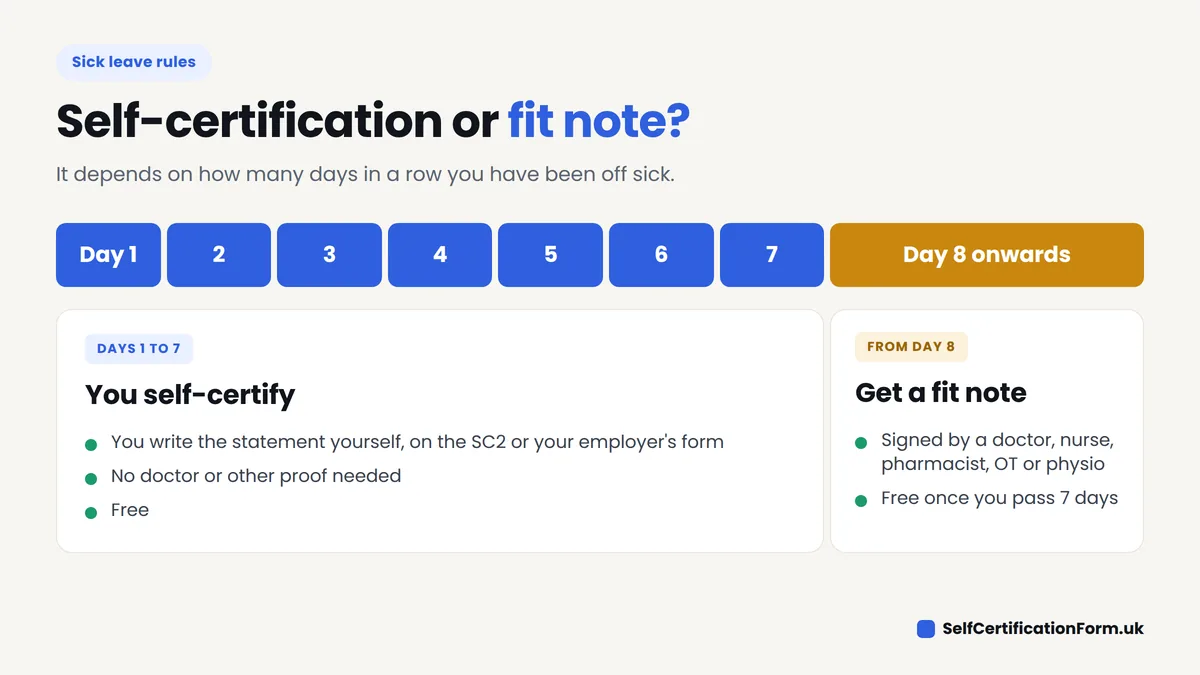
Most of the confusion over self-certification vs fit note comes down to one number: seven. If you are off sick for seven days or fewer, you write your own statement. That is self-certification. If you are still ill after day seven, a doctor or another healthcare professional signs a fit note. Weekends and bank holidays count towards the seven days.
| Self-certification | Fit note | |
|---|---|---|
| Who writes it | You | A healthcare professional |
| Covers | Up to 7 days off sick | More than 7 days off sick |
| Medical opinion | No, it is your own statement | Yes, after an assessment |
| Cost | Free | Free once you have been off for more than 7 days |
| Where you get it | The SC2 form, or your employer's own form | Your GP surgery or another registered professional |
When You Can Just Self-Certify
For an illness of seven days or fewer, GOV.UK says you do not need a fit note or any other proof from a healthcare professional. When you come back, your employer can ask you to confirm that you were off sick. You and your employer agree how you do that. It might be a form, or it might be an email.
The official form is the SC2, but many employers have their own. Either way, the content is the same: your name, the dates you were off and a short reason.
Fill it in on your first day back, while the dates are fresh in your mind. Write the exact days, not "about a week". A clear form saves your payroll team a follow-up question.
When a Fit Note Takes Over
You need a fit note if you have been ill for more than seven days in a row. The count includes weekends and bank holidays, so a day you were not meant to work still counts.
Here is how that looks. Say you go off sick on a Friday. Day 7 is the following Thursday. If you are still unwell on Friday, that is day 8, and you need a fit note from then on. ACAS says to give it to your employer on day 7, or as soon as possible after.
A surgery may refuse to sign a note before day seven, so do not wait until the last minute. Ring on day 6 or 7 and ask for an appointment. A bank holiday weekend can use up three of your seven days before you know it, because the 7 day rule counts calendar days, not working days.
What a Fit Note Actually Says
A fit note gives one of two answers about your health:
The professional says you should stay off work. Your employer has nothing more to decide.
You could do some work with support, such as different hours or lighter tasks.
If your note says "may be fit for work", your employer should talk to you about the changes it suggests. These can include a phased return, altered hours, different duties or changes to your workplace. If you and your employer cannot agree on the changes, GOV.UK says you must be treated as not fit for work.
You keep the original note. Your employer can keep a copy.
Who Can Sign a Fit Note?
It does not have to be your GP. These professionals can all issue one:
- A GP or hospital doctor
- A registered nurse
- An occupational therapist
- A pharmacist
- A physiotherapist
They must assess you before they sign, and that can be in person or by phone. If your employer agrees, an AHP Health and Work Report can replace the fit note. It cannot be used to claim Employment and Support Allowance.
What Does a Fit Note Cost?
Nothing, as long as you have been ill for more than seven days when you ask for it. In the first seven days it is different. A professional can charge a fee if your employer asks for evidence that early, and the NHS says your employer should pay it.
If you are asked to pay for a note in your first week, check with your employer before you hand over any money.
Can Your Employer Ask for a Fit Note Early?
ACAS says an employer should only ask for a fit note from the seventh day of absence. Before that, a simple self-certification is enough. If your manager asks for a doctor's note after two days off, politely point to the ACAS guidance and ask who would pay the fee.
Check your contract and staff handbook too, because some employers have their own sickness rules. If you are unsure where you stand, ACAS runs a free helpline.
What If You Cannot Get an Appointment in Time?
It happens, especially around bank holidays. Do not stay silent. Tell your employer the same day, explain that you are trying to book, and say when you expect to have the note. Keep a note of who you rang and when, in case anyone asks later.
Two Examples
Priya has a stomach bug and is off from Monday to Friday. She goes back the following Monday and fills in her employer's self-certification form that morning. She does not see a doctor.
Daniel hurts his back on a Wednesday. By the following Monday he is still in pain, so he rings his surgery and books a phone appointment. The nurse signs a fit note that says "may be fit for work" with altered hours. Daniel gives it to his manager, and they agree a shorter working day for two weeks.
How Both Affect Your Sick Pay
Self-certifying does not mean you lose sick pay. ACAS says you should still be paid the sick pay you are entitled to for a self-certified absence. A fit note then supports your claim once you pass seven days.
Neither document changes how much you get. That depends on your contract and on how Statutory Sick Pay works after the April 2026 changes. Check the current figures on GOV.UK before you rely on a number.
Frequently Asked Questions
Is a fit note the same as a sick note?
Yes. "Sick note" is the everyday name. "Fit note" is the official one. Both mean the signed statement from a healthcare professional that says whether you can work.
Do I need a fit note for 3 days off sick?
No. If you are off for seven days or fewer, you do not need a fit note or any other proof from a healthcare professional. You can self-certify instead.
Does the seven days include weekends?
Yes. The seven days are calendar days. Weekends and bank holidays count, even if you were not due to work them.
Can I self-certify for longer than seven days?
No. If you are ill for more than seven days in a row, you need a fit note from a healthcare professional. Hand it to your employer on day seven, or as soon as you can after.
Who pays for a fit note?
Nobody pays if you are off for more than seven days. In the first seven days, a professional may charge a fee if your employer asks for evidence, and your employer should pay it.
Can a pharmacist or nurse sign a fit note?
Yes. A GP, hospital doctor, registered nurse, occupational therapist, pharmacist or physiotherapist can sign one. They must assess you first.
Can I go back to work before my fit note runs out?
Yes. You can return as soon as you feel able. You do not need to see a healthcare professional again, although your employer may ask you to confirm you are well enough.
Reviewed by our HR & Employment content team. Checked against current GOV.UK and ACAS guidance on Statutory Sick Pay and sickness absence. Last reviewed 14 October 2026.