Self Certification Form UK
Complete a self-certification form for sickness absence. Fill it in, download a printable copy, and find out exactly when you need to self-certify your sick leave.
Write your letter in about two minutes
Answer a few simple questions and the tool writes a properly worded self-certification letter for you. Download it as a PDF, sign it, and hand it to your manager or HR team.
- Four short steps, with checks so nothing gets missed
- Your details stay on your device and are never uploaded
- Works on phones, tablets and computers
- Switches to fit note wording if your absence runs past 7 days
What Is a Self Certification Form?
This is the form you fill in and give to your employer after being off work sick for seven days or less. It is short, quick to complete, and does not need a doctor's signature.
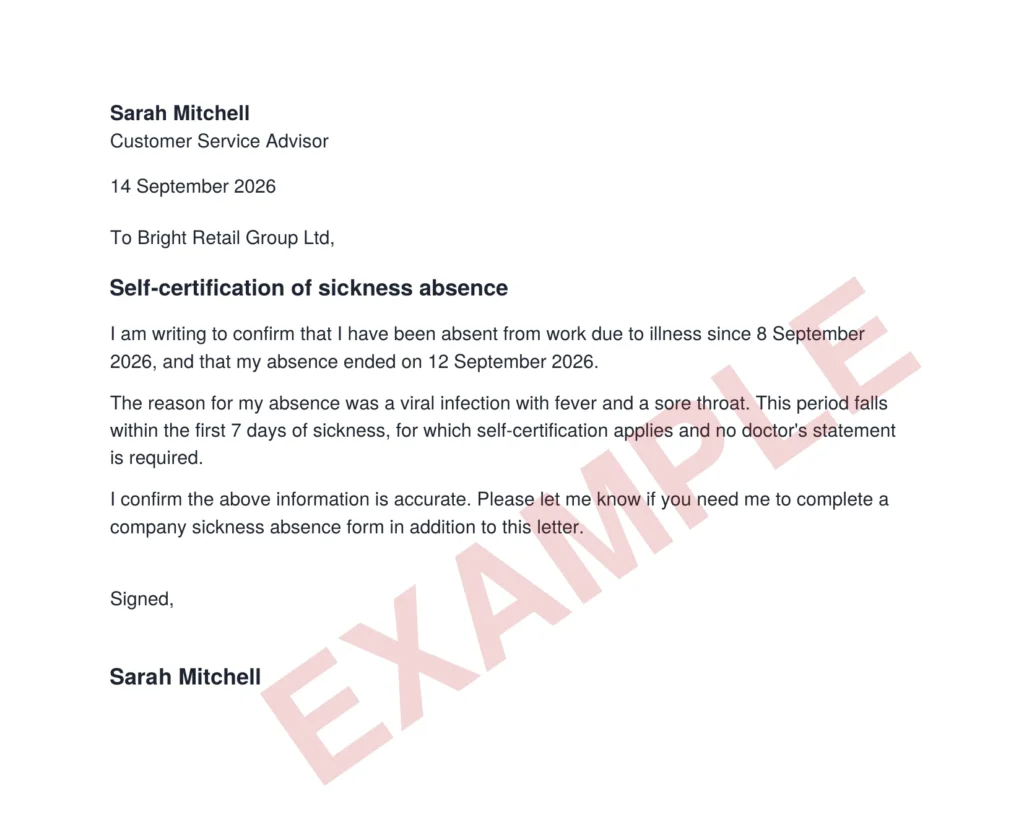
A self-certification form is used by an employee to tell their employer that they have been off work because of illness. It records the dates of sickness absence and is completed by the employee, not a doctor, which is where the word "self" in the name comes from.
The form gives your employer a written record they can rely on for their own files, and it supports any Statutory Sick Pay you are owed. Rules about self-certification have been part of UK sick pay since Statutory Sick Pay began in 1983. Before then, employees needed medical evidence from day one of any illness, which meant GPs were signing off common, short illnesses instead of seeing patients who genuinely needed an appointment.
You might also see this called a self certification illness form or a self certification sickness form. All three names describe the same document: your own written statement covering the first seven days of an illness.
When Can You Self-Certify?
UK law splits sickness absence into two clear stages, depending on how long you have been off. This is often called the self certification form 7 days rule.
Some workplaces have their own procedure or form for short absences. Check with HR if you are unsure which one to use.
How to Complete the Form
The self-certification form only asks for a handful of details. Here is what you will need to fill in, and how to self certify for short term illness in the UK without any guesswork.
Employee name and details
Your full name and job title, so the form can be matched to your personnel record.
First day of sickness
The date your illness started, even if that was a non-working day.
Last day of sickness or expected return date
Either the date you returned to work, or your expected return date if you are filling this in while still off.
Reason for absence
A brief description is enough. You do not need to give full medical detail.
Employee declaration and signature
A short statement confirming the information is accurate, followed by your signature.
Date completed
Usually the date you return to work and hand the form in.
How it looks in real life
Two short examples show where self-certification stops and a fit note starts. The 7-day rule is explained in full in our article on how the seven days are counted.
Sarah wakes up with a bad cold on a Tuesday and is back at her desk on Friday. She fills in her form on her first day back, covering Tuesday to Thursday.
Tom comes down with flu on a Saturday and returns the following Friday, seven calendar days later. His whole absence sits inside the self-certification window.
Self Certification vs Fit Note vs SC1
Three documents that get confused constantly, including by people searching for the wrong one entirely.
| Self-cert vs fit note? | A self-certification form is your own written statement, used for the first seven days. A fit note is signed by a doctor and needed from day eight onward, or sooner if your employer's policy asks for one. |
| SC2 vs SC1? | SC2 is for employees claiming Statutory Sick Pay. SC1 is a different form, used by self-employed people or those not eligible for SSP, to support an Employment and Support Allowance claim instead. |
| Self-cert vs return-to-work form? | Related but not identical. A return-to-work form covers a wider back-to-work conversation. Self-certification specifically evidences the illness itself for SSP purposes. |
What Is Statutory Sick Pay (SSP)?
Statutory Sick Pay is the minimum amount your employer must pay you while you are off work sick, provided you meet the eligibility rules. Your self-certification form is the evidence your employer uses to support that payment for your first seven days off.
The weekly rate is set by the government and reviewed each tax year, so it is worth checking the current figure on GOV.UK rather than relying on a number quoted elsewhere, since older figures circulating online can be out of date. Self-certification does not change the rate, only whether a doctor's note is needed to claim it.
What Is the New Rule for Sick Pay in 2026?
From 6 April 2026, you need to have been off work sick for at least one full working day before you qualify for Statutory Sick Pay. That's a change from the previous waiting-day rules, so use this as your current starting point rather than older sick pay advice still circulating online.
Self-certification itself hasn't changed. You can still confirm up to seven days of illness yourself, without a doctor's note. What's changed is only how soon SSP payments can start once you meet the eligibility conditions.
What Is the SC2 Form?
The SC2 form is HMRC's official self-certification template, formally called the Employee's Statement of Sickness. It is the sc2 self certificate form most people find when they search GOV.UK.
Using the SC2 is not a legal requirement. Employers may have their own self-certification form or internal process instead, as long as it captures the same basic information. If your workplace does not provide a form, the SC2 is a safe, standard option to fall back on.
One detail worth knowing
The SC2 is evidence, not a claim in itself. Your employer still decides your Statutory Sick Pay eligibility and pays it through your normal wages, using the form to support their record.
A different form entirely
If you are self-employed, the SC2 does not apply to you at all, since there is no employer to submit it to. Self-employed people use the SC1 form instead, to support a claim for Employment and Support Allowance rather than Statutory Sick Pay. It looks similar but serves a different benefit entirely.
Is There a Separate NHS Self-Certification Form?
Many people search for an nhs self certification form, expecting the NHS to issue its own version. It doesn't. NHS staff use the same process as any other UK employee: either their trust's internal form or the standard SC2. The seven-day rule applies in exactly the same way.
A GP surgery can charge a private fee for a certificate covering an illness under seven days, since the NHS doesn't fund short-term sickness certificates.
The mix-up usually comes from GP surgeries handling notes after day seven. Self-certification exists partly to avoid that unnecessary appointment and cost.
Self Certification Form PDF
Need a printable copy? Download the self-certification form as a PDF, print it, and complete it by hand before giving it to your employer.
Download PDFSelf-Certification for Employers
Employers are entitled to ask for self-certification evidence for any absence of four days or more, to support their Statutory Sick Pay records, but cannot demand a doctor's note for the first seven days of an illness.
You are free to design your own self-certification form rather than using the SC2, as long as it collects the same basic details: the employee's name, their dates of absence, and the reason given. Keep completed forms on file as part of your standard absence record, since they can matter later if a payroll query or dispute comes up.
Employers can
- Ask for evidence once an absence reaches four days
- Use their own form instead of the SC2
- Set clear rules for how and when staff report sickness
Employers cannot
- Demand a doctor's note for the first seven days
- Insist on the SC2 itself, as it is not a legal requirement
Can I Self-Certify for My Last Week of Work?
Yes. If you're off sick during your final week in a job, whether you're resigning, being made redundant, or reaching the end of a contract, the same self-certification form 7 days rule applies. Your employer still needs a record of the absence, and you may still be entitled to SSP for those days even though you're leaving.
Who Needs This Form?
Not every short absence needs paperwork straight away. Here is how the common situations differ.
You'll likely need one if…
- You've been off sick for 4 to 7 calendar days
- Your employer needs evidence for Statutory Sick Pay
- You're returning to work after a short illness
You probably don't if…
- You were off for a single day (policies vary)
- You're already 8 or more days into an illness, a fit note is needed instead
- You're self-employed, the SC1 form applies to you instead of SC2
Self Certification Form Not Accepted?
My employer wants a doctor's note for a 3-day absence
Employers cannot legally require a doctor's note for the first seven days. If this keeps happening, raise it directly with HR, since GPs are also asked not to use NHS appointments for short absences under seven days.
I've lost track of my exact dates
Check messages or emails you sent your employer at the time, these usually carry a timestamp that confirms when your absence started.
My form was submitted late
Most employers allow a reasonable window, often a few days after your return, but check your workplace's own absence policy for the exact deadline.
Getting it right
- Never backdate a form to cover days you weren't actually unwell, this can be treated as misconduct.
- Keep a copy of anything you submit, in case of a payroll query later.
- If unsure what your employer requires, ask HR before your return rather than guessing.
Where this information comes from
We write from official sources and recheck them when the rules change. If you want to confirm anything yourself, start here.
Frequently Asked Questions
What is a self-certification form?
It's a short statement you write yourself to confirm you've been off sick, covering the first seven days of an illness without needing a doctor's note.
How long can I self-certify when I'm sick?
Up to seven calendar days, including weekends and bank holidays. From day eight you'll usually need a GP fit note.
Do I need a doctor's note for 7 days off sick?
No. Self-certification covers the full seven days on its own. A doctor's note is only needed from an eighth consecutive day off.
What is the SC2 form?
SC2 is HMRC's official self-certification template for employees. It's not a legal requirement, but it's the standard fallback if your employer has no form of their own.
Can my employer use its own self-certification form?
Yes. Employers can use any format, as long as it captures your name, your dates of absence, and the reason given.
Is there a separate NHS self-certification form?
No. NHS staff follow the same rule as everyone else, using either their trust's internal form or the standard SC2.
What happens if I'm sick for more than 7 days?
You'll generally need a fit note from your GP to cover the period from day eight onward, to keep your Statutory Sick Pay going.
Do I need to give my employer a diagnosis?
No. A brief description of the illness is enough on a self-certification form, you don't need to provide full medical detail.
Is there a separate NHS self-certification form?
No. NHS staff follow the same rule as everyone else, using either their trust's internal form or the standard SC2.
Can I self-certify for my last week of work?
Yes. The same seven-day rule applies even if you're resigning, being made redundant, or reaching the end of a contract.
Can I fill in a self-certification form online?
Yes. Use the free tool on this page to answer a few questions and download a finished letter as a PDF. You can also print the blank form and fill it in by hand.
Are my details stored when I use the online tool?
No. The letter is built in your own browser, so your name, dates and reason never leave your device.
What if I'm off sick again within 8 weeks?
Two absences within 8 weeks of each other can be linked together for Statutory Sick Pay. You still complete a form for each absence.
How much is Statutory Sick Pay?
The weekly rate is reviewed each tax year, check the current figure on GOV.UK rather than an older figure quoted elsewhere.
What is the new rule for sick pay in 2026?
From 6 April 2026, you need to have been off sick for at least one full working day before you qualify for Statutory Sick Pay, a change from the previous waiting-day rules.
Ready to complete your self-certification form?
Free, takes a couple of minutes, and covers your first seven days off sick.
Create My Letter Online