Sick Note for Work Template You Can Copy
Most employers want the same few facts from a sick note, so one template covers nearly every workplace. Copy the letter below, replace the bracketed parts and sign it. If your employer hands you its own form, fill that in instead. It will ask for the same details.
[Your name]
[Your job title]
[Today's date]

To: [Your manager's name]

Self-certification of sickness absence

I was unable to work because of [short reason, for example a stomach bug] from [first day off] to [last day off], including both dates. I was due back at work on [date you returned].

I confirm that I did not work during this time and that the information above is true.

Signed: [Your name]
Date: [Today's date]
Short notes get accepted faster. Your line manager or HR adviser needs the dates and your signature, and payroll uses those dates to work out any Statutory Sick Pay you are owed.
What to Put in a Sick Note for Your Employer
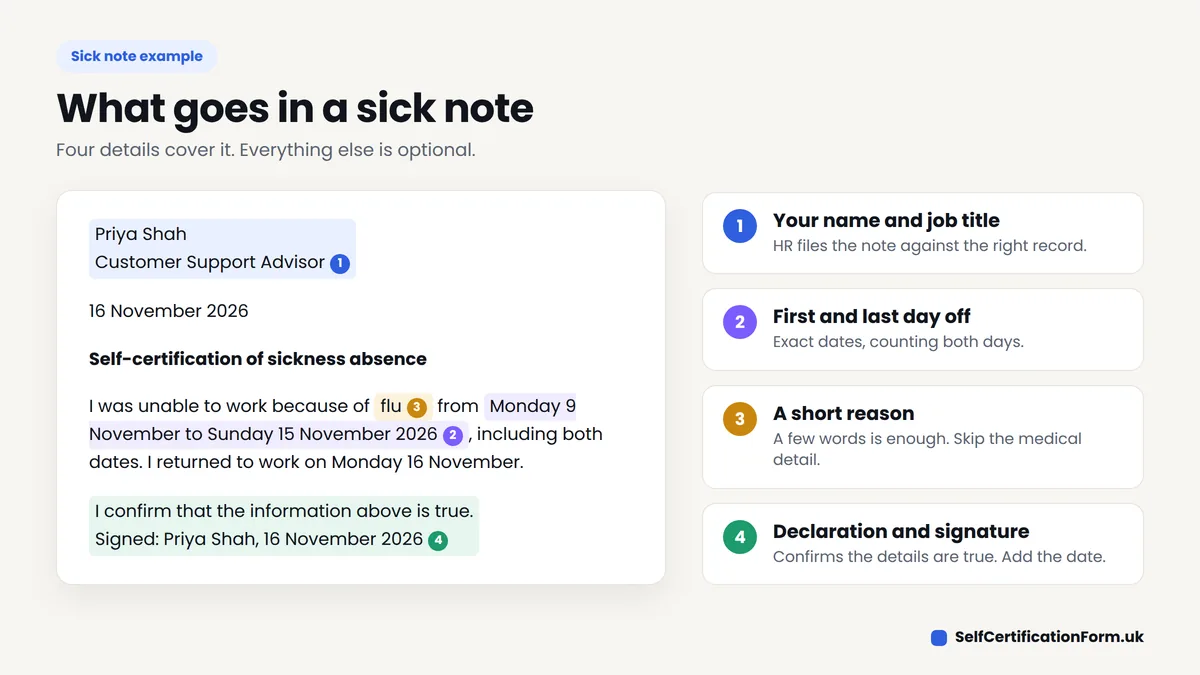
Four details do the job:
- Your name and job title, so HR files the note against the right record
- The first and last day you were off, counting both days
- A short reason, such as a cold, a migraine or a back problem
- A line confirming the details are true, plus your signature and the date
Leave out the medical history. Your employer needs to know you were unwell, not the full story, and a few words protect your privacy. Count weekends and bank holidays if you were ill on them. The dates on your note should match the days you felt unwell, not only the days you were due to work.
Sick Note Examples for Common Situations
A one day absence and a week away need different wording. Copy the one that matches your situation and change the details.
One or two days off
Most workplaces accept an email for a short absence. Send it on the day you return:
Subject: Sickness absence, Tuesday 3 November

Hi [Manager's name],

I was off sick on Tuesday 3 November because of a migraine. I am back at work today. If you need me to fill in a form for my records, I am happy to do that.

Thanks,
[Your name]
A full week off
After a longer absence, give your manager a signed letter. This one covers seven days, which is the most you can cover yourself:
Priya Shah
Customer Support Advisor
16 November 2026

To: Mark Evans

Self-certification of sickness absence

I was unable to work because of flu from Monday 9 November to Sunday 15 November 2026, including both dates. That is seven days, so I am confirming the absence myself. I returned to work on Monday 16 November.

I confirm that I did not work during this time and that the information above is true.

Signed: Priya Shah
Date: 16 November 2026
Telling your manager you are off sick
This message comes before any sick note. Send it as early as you can on the first morning, and follow your absence policy if it names who to contact:
Hi [Manager's name],

I am not well enough to work today. I am not sure how long I will be off, so I will message you again tomorrow morning. Please let me know if you need anything from me before then.

[Your name]
How to Write a Sick Note in Five Steps
- Write it when you are back at work. The dates are fresh, and you know exactly how long you were off.
- Count from the first day you could not work. Include any weekends and bank holidays you spent ill.
- Give a short reason. One or two words is plenty.
- Add the declaration. Write that the details are true, then sign and date the note.
- Hand it in and keep a copy. Give it to your line manager or HR, whichever your staff handbook names, and keep a copy for your own records.
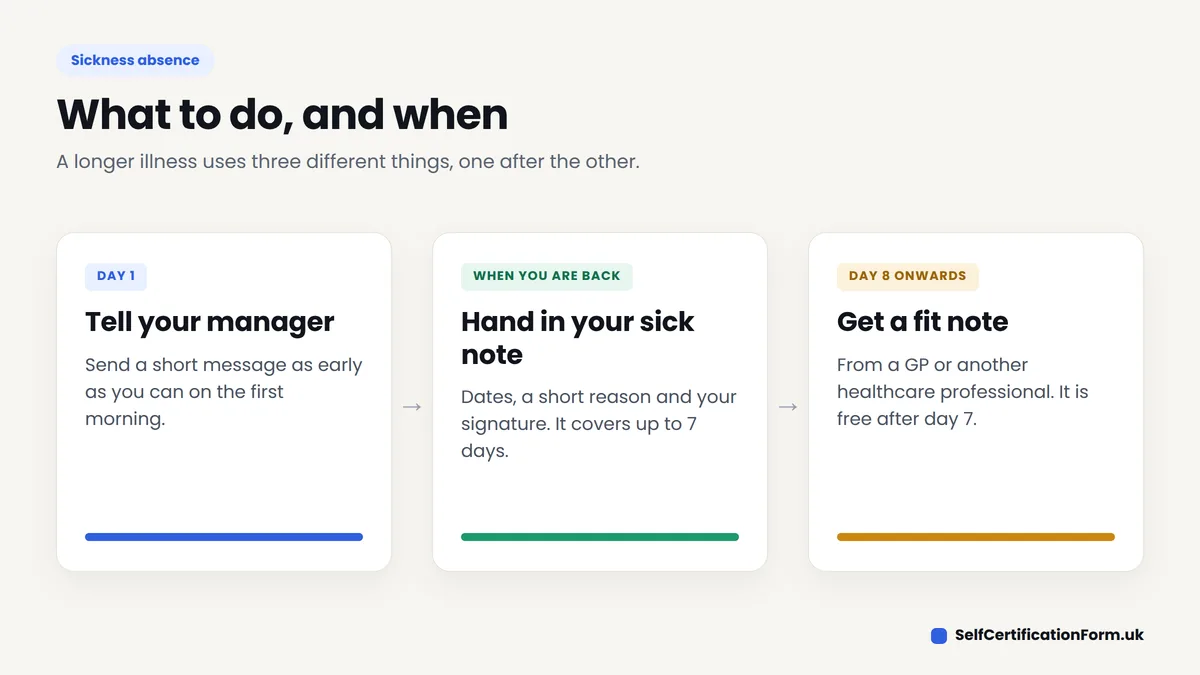
This is how the pieces fit together across a longer absence:
Mistakes That Hold Up Your Sick Note
Notes usually come back for one of a few small reasons:
- Vague dates, such as "last week", instead of the exact first and last day
- Medical detail your employer never asked for
- A missing signature or date
- A note sent to the wrong person, so check your absence policy for who handles it
- No copy kept for you
What Happens After Seven Days Off
Your own sick note covers the first seven days of illness. If you are still unwell on day eight, your employer will ask for a fit note from a GP or another healthcare professional. Weekends and bank holidays count towards the seven days, so if you fall ill on a Friday, day seven is the following Thursday.
ACAS sets out the rules on proof of sickness, and your contract or staff handbook may add steps of its own.
Frequently Asked Questions
Can I write my own sick note for work?
Yes, as long as you are off for seven days or fewer. GOV.UK says you do not need proof from a healthcare professional for that time. Your employer can still ask you to confirm in writing that you were off sick, and the two of you agree how.
Does a sick note have to be signed by a doctor?
Not for the first seven days. After that, you need a fit note from a doctor, nurse, pharmacist, occupational therapist or physiotherapist.
How do I write a sick note for one day off?
Keep it brief. Give the date, a few words on why you were off, a line saying the details are true, and your name. The one day example above works as an email or a printed note.
Is an email or text enough to tell my employer I am sick?
Often it is, but your employer's sickness policy decides. Check your staff handbook or ask HR how they want to be told, and how they want you to confirm it once you are back.
Do I have to say what is wrong with me?
Your employer may ask for a reason, but a short one is usually enough, such as a cold or a back problem. You do not need to give medical detail.
Can I use this template for any employer?
Yes, it suits most workplaces. If your employer has its own form or policy, use that instead and keep a copy of what you hand in.
Reviewed by our HR & Employment content team. Checked against current GOV.UK and ACAS guidance on Statutory Sick Pay and sickness absence. Last reviewed 19 October 2026.