Nobody wants to do sums when they feel rough. You wake up with a streaming cold or a bad back, ring in sick, and one thought sits at the back of your head: will this week's pay take a hit?
For most employees the answer is no, or at least not a big one. Sick pay for the first 7 days now starts on day one, and you do not need a doctor to back you up. The rules changed in April 2026, so anything you read from before then is out of date.
What sick pay do you get in the first 7 days?
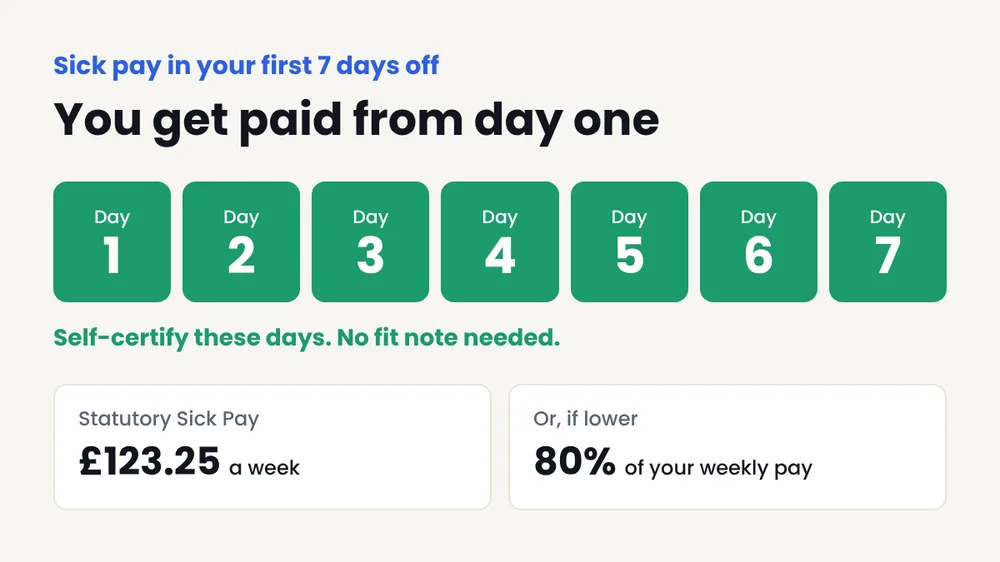
If you work as an employee, your employer must pay you Statutory Sick Pay (SSP) from the first day you are off. Until 6 April 2026 you had to sit out three unpaid "waiting days" first. Those have gone.
SSP covers your qualifying days, which are normally the days you would have worked. Say you work Monday to Friday. Five days count each week and the weekend does not.
Plenty of employers go further than the legal minimum and pay full wages for a set number of days. People call this company sick pay. Your contract or staff handbook will tell you, and it is always worth a look before you assume the lower rate.
How much is SSP a week?
The weekly rate is £123.25. If 80% of your average weekly pay comes to less than that, you get the smaller figure instead.
| Your average weekly pay | 80% of that | You get a week |
|---|---|---|
| £100 | £80.00 | £80.00 |
| £150 | £120.00 | £120.00 |
| £200 | £160.00 | £123.25 |
| £400 | £320.00 | £123.25 |
Payroll looks back at the 8 weeks before you fell ill to work out your average. They then split the weekly rate across the days you normally work to get a daily figure.
Priya earns £400 a week and misses 3 working days with flu. Her daily SSP is £123.25 divided by 5, which is £24.65. Three days comes to £73.95.
That is a lot less than most people earn, so a short absence can still dent your budget. If money is tight, ask your manager or HR whether any extra pay applies.
Do you need a fit note in the first week?
No. For the first 7 calendar days you simply tell your employer you were ill. That is called self-certification, and it means no GP appointment and no paperwork from a doctor. Your employer cannot hold back SSP only because you have no medical note.
From day 8 you normally need a fit note. Some contracts ask for proof earlier, so check yours. Weekends trip people up, so it helps to see exactly how the 7 days are counted.
Self-certifying does not mean lower pay. You get the same SSP either way. Only the proof you hand in is different.
Who can claim sick pay in the first 7 days?
You can usually claim SSP if you:
- work as an employee and get paid through PAYE
- are too ill to work
- report your illness to your employer on time
Agency workers and many people on zero hours contracts count as employees here, so they often qualify. The old lower earnings limit has also gone, which means part time and low paid staff are no longer left out.
Self-employed people cannot claim SSP. Universal Credit or New Style ESA may help instead, depending on your situation.
How to report your sickness
Follow your workplace's rules for calling in sick. If there are none, tell your employer within 7 days of your first day off. Leave it longer and they can delay your pay.
- Ring or message your manager as early as you can on day one.
- Say you are ill and give a return date if you have a rough idea.
- Fill in your employer's self-certification form when you are back, or write a short letter yourself.
No form at work? Our free letter generator builds one from your name, dates and a short reason.
What changes after the first 7 days?
SSP runs for up to 28 weeks, as long as you stay off sick and send in a fit note. Two spells less than 8 weeks apart count as one, so they share the same 28 weeks. You can read the full rules on the Acas site.
Questions people ask about week one
Do I get sick pay on the first day off?
Yes. Since 6 April 2026, SSP starts on your first day off sick. The old three waiting days no longer apply.
Do I need a fit note to get sick pay in the first week?
No. You can self-certify for the first 7 calendar days. You only need a fit note from day 8, or sooner if your employer asks.
How much is Statutory Sick Pay a week?
It is £123.25 a week, or 80% of your average weekly earnings if that comes to less.
Can I get sick pay if I earn very little?
Yes. The lower earnings limit has gone, so low earners now qualify. You receive 80% of your average weekly pay if that is under the weekly rate.
Do weekends count in the first 7 days?
They count as calendar days, but SSP only pays for your qualifying days. Those are usually the days you normally work.
Can my employer refuse sick pay for the first week?
Not if you qualify. Your employer can ask you to follow its reporting rules and may pay late if you ignore them, but it cannot skip SSP you are owed.
Reviewed by our HR & Employment content team. Checked against current GOV.UK and ACAS guidance on Statutory Sick Pay and sickness absence. Last reviewed 25 October 2026.